This page explains how to calculate entropychanges for different thermodynamic processes, such as isothermal, isobaric, isochoric, adiabatic changes, and phase transitions.
The second law says that the entropychange must be equal to or greater than zero. This corresponds to the statement that heat must flow from the higher temperature source to the lower temperature source.
The changeinentropy is inversely proportional to the temperature, meaning that as the temperature rises, the change in entropy decreases, whereas as the temperature falls, the change in entropy increases.
Entropychange is represented by ΔS, which is actually a measure for a process determined by the heat transfer, Q, in relation to the temperature at which it is transferred, T: ΔS = Q / T.
Working out entropychanges for a reaction is very easy. You add up the entropies for everything you end up with, and take away the entropies of everything you started with.
These formulas appear throughout thermodynamics, statistical mechanics, and chemical equilibrium, making them essential tools for everything from predicting reaction spontaneity to understanding phase transitions.
The entropy change formula is ΔS = Q/T, where ΔS represents the change in entropy, Q is the heat transfer, and T is the absolute temperature. It quantifies the shift in disorder or unpredictability during energy transformations.
We can calculate the Entropy Change of a chemical reaction or a system by using the change in entropy formula: ΔS = (Q/T)rev. Where, Q is the heat transfer to or from the thermodynamic system. T is the absolute temperature. The SI unit of Entropy Change is J/Kmol.
Equation 5.3 is in terms of specific quantities. For moles of gas, This expression gives entropychange in terms of temperature and volume. We can develop an alternative form in terms of pressure and volume, which allows us to examine an assumption we have used.
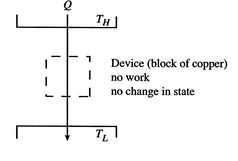 The second law says that the entropy change must be equal to or greater than zero. This corresponds to the statement that heat must flow from the higher temperature source to the lower temperature source.